
Personal Branding Framework for PR Agencies: 7 Steps to Faster Client Results
The steps most agencies are rushing through, and why it's costing everyone time, money, and more than a few awkward client calls.
Somewhere between "we have a great strategy" and "why isn't this moving faster," something is getting lost.
It's not the strategy.
The strategy is fine.
It's the steps underneath the strategy that nobody wants to admit are being held together with duct tape and a ChatGPT window.
Here's what actually happens inside most personal branding campaigns: the high-value, creative, clearly-billable work gets done well.
Then comes the part that is repetitive, research-heavy, and genuinely tedious to do properly at scale. That part gets abbreviated.
Someone asks ChatGPT to fill the gap. ChatGPT, with the confidence of someone who has never once been wrong in its own mind, produces the same answer it gave the last 400 people who asked the same thing.
The campaign looks solid in the deck. In practice, it moves at the pace of cold honey. Clients are not getting featured as fast as they should. The team is working twice as hard for half the velocity. And somewhere in a client check-in, someone is very professionally explaining why month three looks a lot like month one.
Through years of trial and error and then a pivot when AI agents became a thing, I've built a 7-step personal branding framework that consistently gets clients onto industry-leading podcasts, stages, and publications within 30 days. Even the ones starting from blank socials and zero online presence.
And I want you to have it.
What makes it work isn't magic, and it's not just the steps themselves. It's knowing exactly which steps need real human judgment, and which ones have been eating your team's hours for absolutely no reason.
Here's the full framework, and more importantly, where the gaps tend to live unnoticed.
Step 1: The Story

Everything starts here. A thought leadership story is not a bio, not a credentials list, and not a highlight reel of your client's greatest professional moments.
It is the specific, defensible intersection of three things: what your client is uniquely great at, what their target audience is actively searching for right now, and where your client has real proof to back it up.
Get this step right and every other step has somewhere to go. Get it wrong, or worse, skip the market research part and go with your gut, and you spend the next three months building a very impressive sandcastle.
Where agencies lose time here: Treating this step as a creative exercise instead of a research exercise. "We know their audience" is doing a lot of heavy lifting as a sentence, and it usually means the team knows their audience from six months ago, on the platforms they were tracking six months ago, using language that may or may not be how that audience is actually talking right now. That gap shows up fast once the content starts going out.
Step 2: The AEO Content Engine
Your clients' audiences are not just Googling things anymore. They are asking ChatGPT. They are prompting Claude, Perplexity, Gemini, and whatever new one launched last Tuesday for information.
The businesses and thought leaders who show up in those AI-generated answers are the ones consistently creating content around the exact questions being asked today, not the questions someone approximated three months ago during a strategy session.
This is Answer Engine Optimization, or AEO. It changes what a good content brief looks like entirely.
Every piece of content needs to be grounded in real, current search data across both traditional search and LLMs, and it needs to be answered through your client's unique story and specific perspective.
Generic takes, even well-written ones, do not cut through. Only your client's actual experience and point of view can do that.
Where agencies lose time here: Asking ‘GenericGPT’ what topics to write about and then being surprised when the content blends into the background. ChatGPT's suggestions are built on what everyone else has already covered. That is, by design, the opposite of differentiation. Real AEO requires tools that surface what is being searched right now, this week, in your client's actual market. Not vibes. Not assumptions. But real, actionable real-time data.
Step 3: Podcast Outreach

The right podcasts already have your client's exact audience tuned in and paying attention every week. Getting featured on them is one of the fastest visibility levers that exists.
The catch?
The outreach has to be specific enough that the host actually responds, and human enough that it doesn't immediately read like it was assembled by a robot with access to the show's Spotify description.
Because that is what most pitches sound like right now. Podcast hosts know. They get hundreds of these things. The ones that land reference a specific recent episode, connect it genuinely to the client's story, and make a clear case for the gap the client can fill for that audience.
It takes real research. It takes actual listening.
Where agencies lose time here: This step is brutal to do well at volume. Identifying the right shows, reviewing recent episodes, finding the right contact, crafting a pitch that doesn't get auto-deleted, tracking follow-ups across a full client portfolio. Done manually, it is an enormous time sink. Done with GenericGPT, it gets your clients quietly blacklisted by the hosts they most need to reach. This is exactly the step that needs purpose-built AI research agents, not a general-purpose chatbot cosplaying as one.
Step 4: Events and Stages
A speaking slot at the right event does things a podcast cannot. It puts your client in the same room as buyers, decision-makers, and the people who book future speakers, all at once. The compounding effect on authority, relationships, and inbound is real and it is fast.
Getting there requires knowing which events are worth targeting across the next two quarters, who the organizers are, what they have programmed before, and how to pitch a keynote that actually earns a response rather than a polite no-reply.
Before any pitch goes out, your client needs two things: a signature keynote topic built around what their market is searching for right now (hello again, AEO data), and a speaker kit that answers the one question every event organizer is secretly asking, which is "why this person, for my audience, at this moment?"
Where agencies lose time here: Conference and event research is ongoing, repetitive, and easy to deprioritize. Tracking the right events per client industry every quarter, monitoring speaker application windows, finding the right decision-maker at each event. It is exactly the kind of high-repetition research work that should not be eating a human's afternoon.
Step 5: Publications

A byline in the right trade publication borrows the outlet's credibility and sticks it right next to your client's name.
The process requires knowing which publications your client's audience is actively reading, understanding each outlet's editorial angles and submission guidelines, and pitching article ideas that add something genuinely new rather than retreading whatever the last five guest contributors have already covered.
Where agencies lose time here: Publication research and pitch personalization is another step that gets quietly compressed when a team is stretched. When it does, the pitches go generic, editors notice immediately, and a placement that should take three weeks takes three months. Or just never happens.
Step 6: Collaborations
This is the step that gets skipped most often, and it is genuinely one of the highest-leverage moves in the whole framework.
Some of the fastest audience growth your client will ever see does not come from their own efforts. It comes from a well-matched collaboration with another expert who is serving a similar audience from a complementary angle.
Joint webinars, podcast swaps, co-authored content. The kind of partnership where both sides win and both audiences get something they would not have found on their own.
Where agencies lose time here: Finding the right collaborators requires research that is easy to justify skipping when the rest of the to-do list is already on fire. So it gets pushed to "next quarter" indefinitely. This is the step that quietly costs the most in long-term referral and audience growth.
Step 7: The Visibility Flywheel
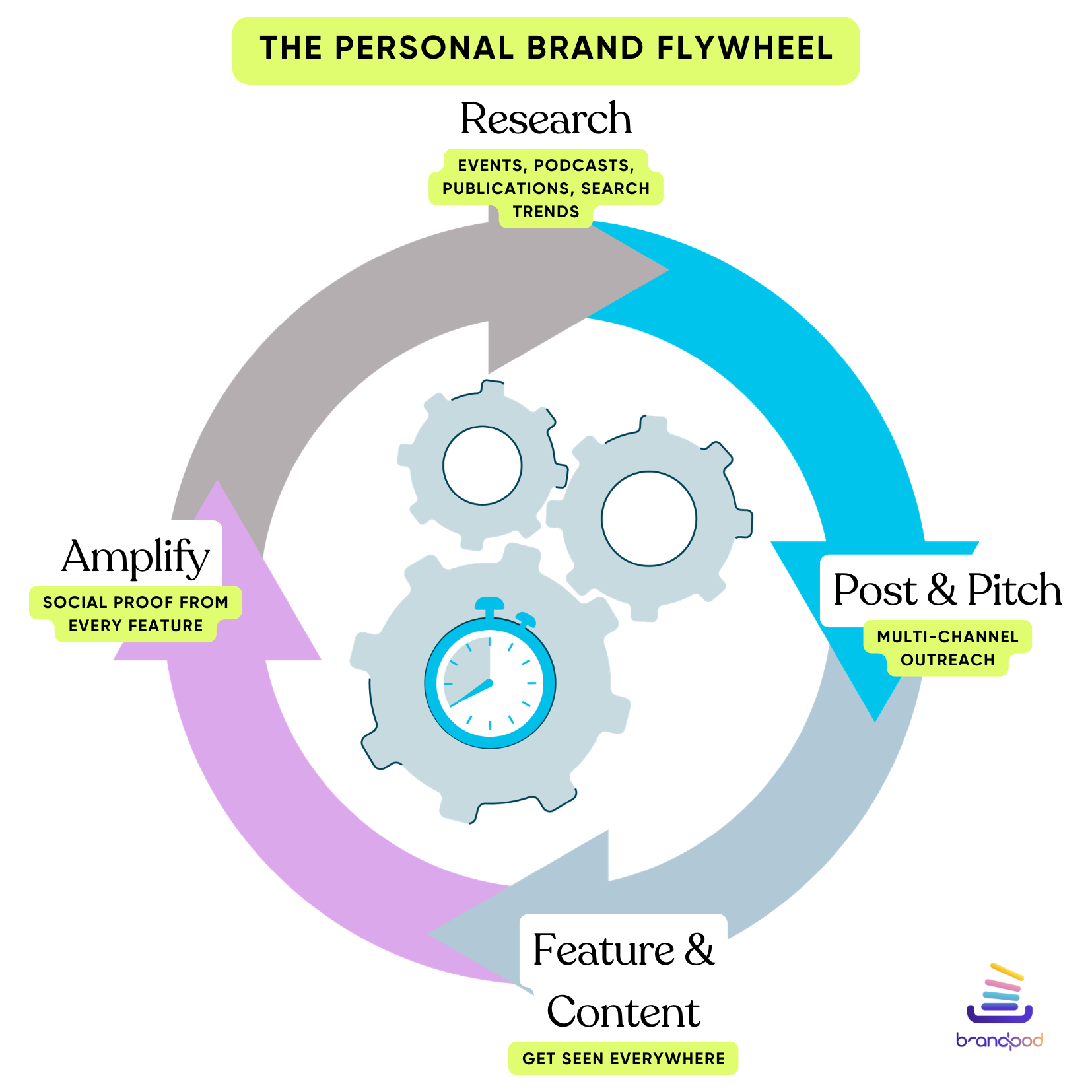
Here is where it all starts getting genuinely fun.
When the six steps above are running with consistency and quality, they stop being separate workstreams and start feeding each other.
Podcast features become proof points for stage pitches.
Publications attract collaboration inquiries.
Content gets amplified across every new channel the client appears on.
Inbound starts doing work that your team used to do manually.
This is the visibility flywheel. It moves slowly at first, then it doesn't. The difference between a flywheel that stalls at Step 3 and one that is spinning well by month two is not the strategy. It is the quality and consistency of the research and execution underneath every single step.
The Part Nobody Talks About in the Debrief
Every step in this framework that gets rushed, approximated, or handed off to ‘GenericGPT’ is a step that produces slower results.
Slower results are expensive, not just in client satisfaction but in the billable hours your team is spending trying to make up for them.
The agencies consistently getting clients featured within 30 days are doing just one key little thing differently.
They’re running each step with purpose-built AI research agents that handle the heavy lifting: market research, podcast and event tracking, outreach intelligence, follow-up sequencing. Not a chatbot that has been asked to approximate all of the above and is doing its cheerful, confident best.
There is a difference. And it shows up in the results.
Frequently Asked Questions
What is a personal branding framework for PR agencies?
A personal branding framework for PR agencies is a repeatable system for building thought leadership and visibility for executive clients across multiple channels — including content, podcasts, stages, publications, and collaborations. The goal is to move clients from invisible to credibly positioned within their industry, ideally within 30 days of starting the process.
Why are PR agencies struggling to get faster results for personal branding clients?
Most agencies have the strategy right but lose time on the research-heavy, repetitive steps in the middle — podcast identification, event tracking, publication pitching, and outreach personalization. When those steps get abbreviated or handed off to generic AI tools, the results slow down significantly. The campaigns that move fastest are the ones running each step with purpose-built research agents, not general-purpose chatbots.
How long does it take to build a personal brand from scratch?
With the right system, it is possible to get a client featured on industry podcasts and at events within 30 days — even starting from zero online presence and blank social media channels. The timeline depends on how thoroughly each step is executed, particularly the story foundation and the market research that drives outreach targeting.
What is Answer Engine Optimization and why does it matter for personal branding?
Answer Engine Optimization (AEO) is the practice of creating content that gets cited in AI-generated answers across platforms like ChatGPT, Claude, and Perplexity, not just ranked in traditional search results. For personal branding, it matters because your clients' audiences are increasingly getting recommendations directly from AI tools. If your client's content is not showing up in those answers, they are invisible to a growing share of their market.
What does a PR agency need to build a personal brand for an executive client?
The essentials are a clearly defined thought leadership story grounded in market research, a consistent AEO content engine, active podcast outreach to the right shows, a speaker kit and signature keynote for event pitching, and a strategy for third-party publications and collaborations. Each of these steps feeds the next, and all of them require current, specific research to execute well.
How is Brandpod different from using ChatGPT for personal branding research?
Brandpod uses purpose-built AI research agents designed specifically for personal branding workflows — identifying what a client's audience is searching for this week, tracking which podcasts are booking guests, surfacing upcoming events, and finding the right publication contacts. General-purpose tools like ChatGPT synthesize existing content, which produces generic suggestions that look reasonable but do not reflect what is actually being searched for right now.
Want to See Exactly How We Tackle Each Step?
Join our free Facebook community for PR and branding professionals.
We share media feature tips, event pitching resources, and the tactics that are getting clients booked on stages right now.
Inside the community, there is a pinned resource that walks through the full seven-step personal branding framework on YouTube, including exactly how we handle event research and speaker outreach without it eating your team's entire week.
Ruheene Jaura is the Founder and CEO of Brandpod. She helps executives and agency teams build personal branding systems that get real results, faster.